
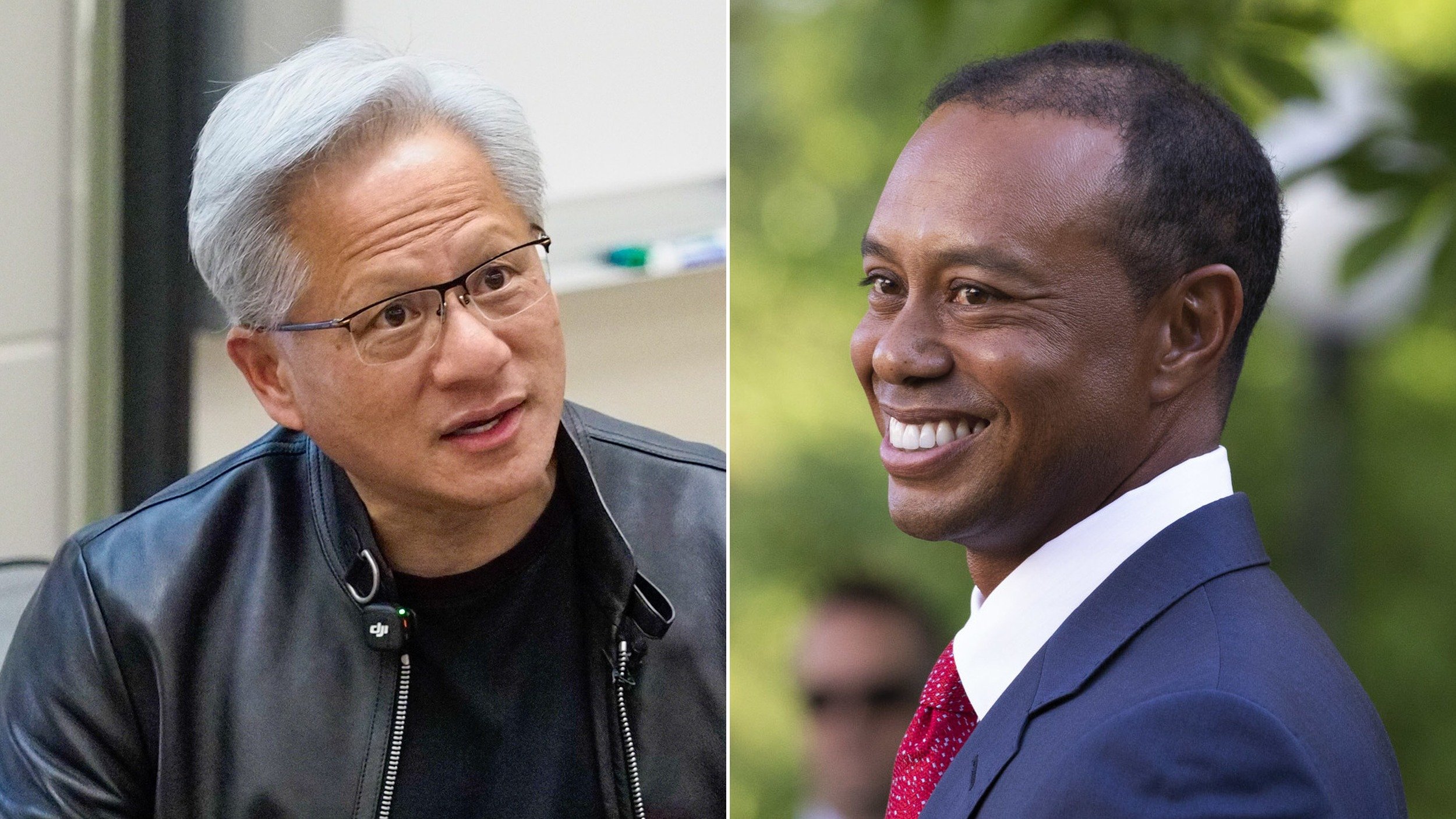
Photos: Anders Eidesvik, CC BY 4.0 (Huang); The White House, public domain (Woods)
Questions about greatness, drive, and what keeps a person whole
By Stephen James
This morning Nvidia’s board announced that Jensen Huang is back as CEO.
Less than two weeks ago he resigned. A few days before that, he had written to every employee: “I was unfaithful to my wife. My actions hurt her and our children. There is no excuse for what I did.” Nvidia’s stock had lost about a third of its value since that note, and today it jumped by about a third, though it’s still well below where it was in October.
Is Jensen Huang Like Tiger Woods?
I keep setting another name beside his: Tiger Woods. My view is that both men deserve our compassion and our encouragement. Pity may be the wrong word, since neither one asked for it. Compassion isn’t.
What Does the Record Show About Huang’s Return?
Here is what the record shows. Huang admitted the affair in that note and named no one. The New York Times and other outlets have reported that the relationship was with Alice Huang, a former executive at Megaspeed, a Singapore company that bought Nvidia chips. She isn’t related to him. Some U.S. authorities suspect she was a Chinese intelligence asset. The Attorney General and others say they haven’t concluded she was a spy, and China rejects the claim. The Justice Department is investigating Megaspeed. As of today, Huang hasn’t been charged with anything. The Times also reported a relationship with an Nvidia executive who was one of his direct reports. Neither Huang nor Nvidia has confirmed that.
What Did Nvidia’s Board Say?
Now the reinstatement. Nvidia says the board voted unanimously after “a series of discussions and meetings” with Huang and was “satisfied with respect to Mr. Huang’s candor and ability to lead.” It also says it took input from “senior levels” of the U.S. government and is confident his return “poses no national security risk.” The board’s own investigation into whether he was the target of a foreign intelligence effort will continue to its conclusion, with Huang’s cooperation. The company has set up a new national security and export control committee and is looking for a chief compliance officer. Huang said he takes the job back “with the greatest humility and renewed commitment.”
None of it is tidy. The board had said as recently as November 17 that it didn’t plan to bring him back, and President Trump, who took credit for it, told CNBC today, “I spoke to them. And I convinced them.” One investor told Reuters the reversal raises governance questions, and governance experts quoted by Axios criticized the board. Congress still wants answers, and Huang is expected to testify next week. Yet WIRED reported that many Nvidia employees had been asking for him back, and one anonymous comment said, “We are all humans and can make mistakes.”
A family was hurt, and colleagues and shareholders were shaken. Huang said as much himself.
What Happened to Tiger Woods?
Tiger’s story is the one most of us know better. He was watching his father hit golf balls at six months old and putting with Bob Hope on national television at two. By 2008 he had won fourteen majors. In November 2009 reports of multiple affairs came out, and the following February he told the cameras, “I was unfaithful. I had affairs. I cheated.” He spent 45 days in inpatient therapy, which the press reported as treatment for sex addiction. In 2017 police found him asleep at the wheel with five substances in his system, and afterward he completed a private intensive program to manage his medications. In April 2019 he won the Masters. Reuters called it “one of sport’s greatest comebacks,” and a good part of the world cheered for a man it had watched fall.
I’d call what Tiger went through two addictions, one of appetite and one of the body, though he never used the word himself. I don’t see Tiger as a villain. I see a man who kept reaching for something to quiet whatever was underneath.
What Do Drive and Addiction Have to Do With Leadership?
Huang’s case differs in a way that matters. The relationships in his case reportedly involve a customer’s executive and someone who worked for him, which makes it a leadership question as well as a personal one. Still, I recognize something in how he talks about himself. “I work every day,” he said in 2023. “There’s not a day that goes by that I don’t work. And if I’m not working, I’m thinking about work.” For decades he has told his company it is thirty days from going out of business. In 2020 he said he wakes up in a panic. Last year he told Joe Rogan the insecurity “doesn’t leave you,” and at Stanford he wished students “ample doses of pain and suffering.”
I’m not diagnosing him. I’ve never met him, and nobody has said he has an addiction. Heck, I’ve felt that same obsession in seasons of my life. Even so, someone who hasn’t been able to rest in thirty years is carrying something heavy, and when that kind of pressure has nowhere to go, it tends to find somewhere.
Drive built what these two built. It also seems to have gotten tangled up with who they thought they were, and when the drive for success is the only place you know yourself, stopping feels dangerous. Something has to quiet the noise, and sometimes it’s the wrong something.
Getting his job back isn’t an indicator that Huang has changed, grown, or learned anything.
What Helps When a Leader Falls in Public?
Nothing here excuses anyone. It does give us a reason to look closer and to be kind while we look. People who fall in public are usually ashamed already. What helps is honesty with a hand held out, a place to tell the truth, people who stay, and a way back. I hope both men find that.
What Does It Look Like When It Goes Right?
I’ve seen what happens when someone does. Years ago I had the privilege of walking alongside R.A. Dickey, and he tells the whole story, including our work together, in his memoir, Wherever I Wind Up: My Quest for Truth, Authenticity, and the Perfect Knuckleball. He was a first-round draft pick who lost most of his signing bonus when doctors found he had no ulnar collateral ligament in his throwing elbow. By his early thirties he was bouncing between the minors and the majors, trying to master the knuckleball. Underneath that, he was carrying far more: sexual abuse as a boy, unfaithfulness in his marriage, and a despair that once led him to try swimming across the Missouri River, where he nearly drowned.
R.A. didn’t fix his career first. He dealt with what was underneath. He told the truth to his wife and to himself, did the slow work of healing, and let people stay close. In 2012, at 37, he won the National League Cy Young Award, the only knuckleball pitcher ever to win it. The trophy is the part people remember. To me, the better part is that he no longer needed the game to tell him who he was.
That’s what can go right.
What Does Success at Any Price Cost a Leader?
Most of us don’t run trillion-dollar companies or play in front of crowds. We lead in smaller rooms, a team at work or a family or a kitchen table, and we make the same trade there, only quieter. Chase success at any price, and the bill comes due later: at home, in our health, and in our self-respect.
We as leaders need to understand the cost of success at any price. If we can’t know ourselves, we can’t lead others. A leader who hasn’t looked at his own hunger will end up asking other people to feed it. Wisdom lives in the heart, and the heart isn’t on a résumé, a trophy, or an earnings report.
Four Questions to Carry
So here’s where I’d start, over coffee if we were sitting across from each other.
What would you still be if the work were taken away tomorrow?
Who gets what’s left of you after your best hours are spent?
What are you willing to pay for the next win, and who else is paying it?
Who would you want standing next to you on your worst day?
You don’t have to answer out loud. It’s better to hear the answer from yourself than from a headline, and better still to say it to someone who loves you.
Be as kind to yourself as you’d be to Tiger, or to Jensen.
Keep heart! Lead On!
Stephen
An Invitation
Most of us never get asked about our own hunger until something breaks. It’s easier to ask it early, with people who tell the truth and stay.
This is a practicing community for that kind of leadership. Leaders gather at Hardison House to slow down, tell the truth, and be challenged with care, so they can lead with more wisdom, clarity, courage, and wholeness.
If you’re looking for a place to practice leading yourself first, we’d welcome a conversation about becoming part of Council Leadership.
Key Insights: Success, Drive, and Self-Leadership
Is Jensen Huang Silicon Valley’s Tiger Woods?
Stephen James makes the comparison himself: both men built something extraordinary, and both fell in public. He asks for compassion and encouragement for each, without excusing anyone.
What does success at any price cost a leader?
The bill comes due at home, in our health, and in our self-respect. The essay’s landing: if we can’t know ourselves, we can’t lead others.
How can drive become a leadership problem?
Drive can get tangled up with who a leader thinks they are. When success is the only place you know yourself, stopping feels dangerous, and pressure with nowhere to go tends to find somewhere.
What helps when a leader falls in public?
Honesty with a hand held out, a place to tell the truth, people who stay, and a way back. People who fall in public are usually ashamed already.
What questions can a leader ask to start?
What would you still be if the work were taken away tomorrow? Who gets what’s left of you after your best hours are spent? What are you willing to pay for the next win, and who else is paying it? Who would you want standing next to you on your worst day?